Welcome to Planktos’ documentation!
Agent-based modeling of small organisms within fluid flows around immersed structures.
Planktos simulates point-particle organisms small enough that their effect on the surrounding fluid is negligible (such as plankton, larvae, tiny insects) as they move through 2D or 3D fluid velocity fields, including flow around immersed structures such as macrophyte beds, protective layers, or larger organisms. Agent behavior can be specified by ODEs, SDEs, or arbitrary code.
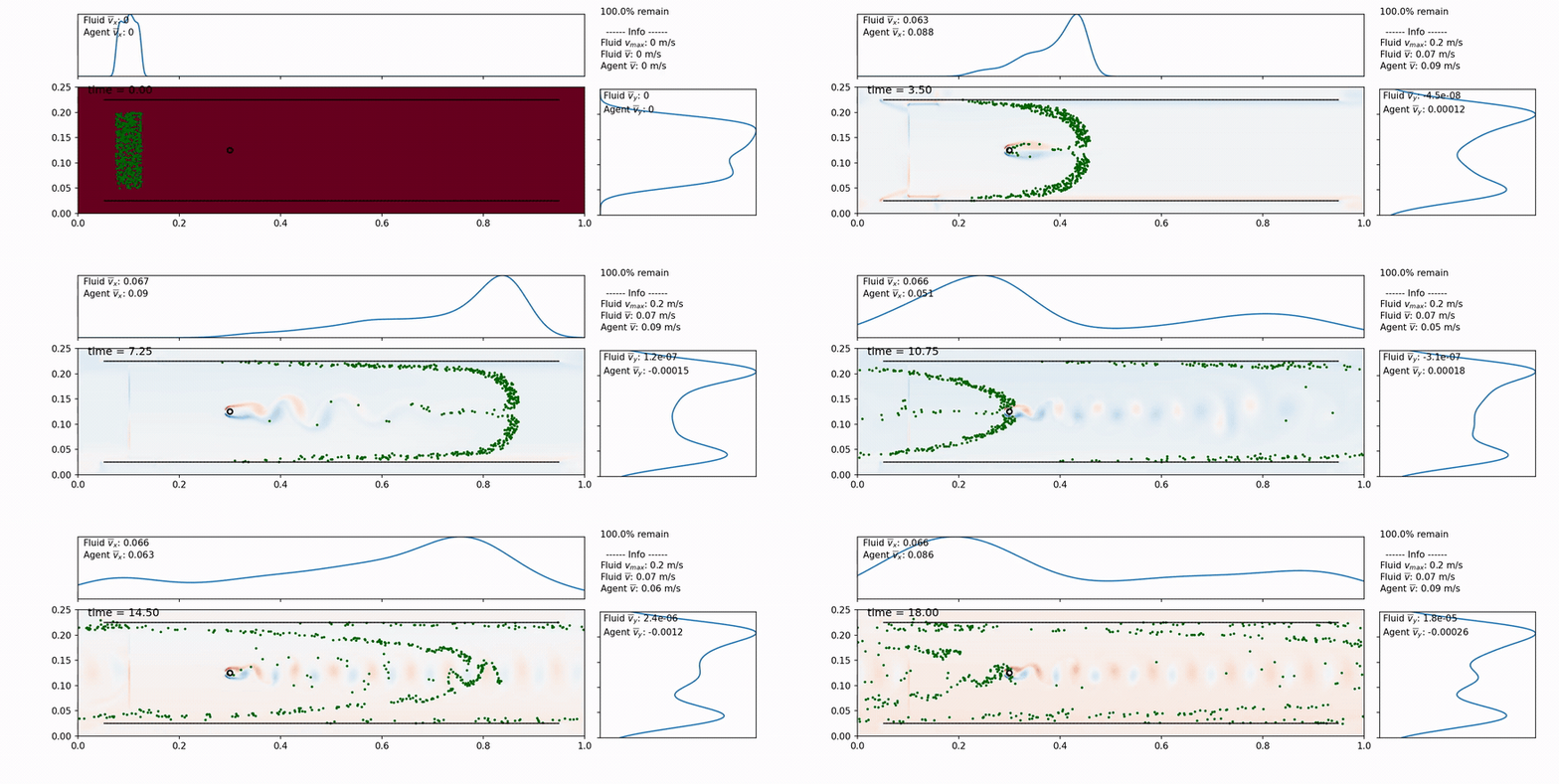
Alignment-only (Vicsek) agents in unsteady flow past an immersed cylinder,
with periodic boundaries. Generated by examples/ex_vicsek_model_2d.py in
the repository.
This is an active research project and work is ongoing – see the releases page for the latest version.
This library can be used for scientific exploration and quantification of collective and emergent behavior, including interaction with immersed structures. Functionality includes:
Arbitrary agent behavior utilizing ODE, SDE, or just a coded algorithm
Loading time dependent CFD-generated velocity fields from VTK or NetCDF formatted data files
Loading immersed STL-formatted mesh structures or vertex points. These mesh structures can be time-varying in 2D, and static in either 2D or 3D.
Agent interaction with immersed boundary meshes as solid structures (frictionless/sliding or sticky collisions).
Data visualization as images or animations with kernel density estimation
Velocity field analysis with respect to deterministic agent behavior via the finite-time Lyapunov exponent.
If you use this software in your project, please cite the following paper:
Strickland, W.C., Battista, N.A., Hamlet, C.L., Miller, L.A. (2022), Planktos: An agent-based modeling framework for small organism movement and dispersal in a fluid environment with immersed structures. Bulletin of Mathematical Biology, 84(72).
A suggested BibTeX entry is included in the file
Planktos.bib.
This project is supported by the National Science Foundation through award number DMS-2410988, 2024-2027. The opinions, findings, and conclusions or recommendations expressed here are those of the author(s) and do not necessarily reflect the views of the National Science Foundation.
Contents: